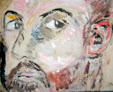
Mario Vargas Llosa's Nobel Prize in literature is welcome for several reasons. It is, first, a well-deserved honor for a brilliant, sensitive, and meticulous writer. I have read all of Vargas Llosa's novels at least once, and I have yet to find a false or poor sentence. The technique in which he, seemingly effortlessly, interlaces scenes from periods years apart in the same chapter is but one example of his superb craftsmanship. The novels are made like fine Swiss watches.
The prize will also bring Vargas Llosa's work and his thinking on literature to a wider audience. His Nobel lecture, on the importance of fiction and reading, can be found here: http://tinyurl.com/25tkp82. It gives some of his personal history and illuminates the motivations behind his work. Those motivations are at least as old as Virgil, which is why no matter when Vargas Llosa's books are set they all seem timeless.
Wednesday, December 15, 2010

Monday, December 13, 2010
St. Mawr and The Man Who Died
D.H. Lawrence's nonfiction has impressed me. But if St. Mawr is any indication of the quality of his novels, Evelyn Waugh must have been correct in being bored stiff by them. St. Mawr is a horse, a magnificent horse, a pulsing, living, arrogantly alive creature. That sentence is an approximation of the Lawrentian style, in which everything is said, nothing is hidden, and all emotions are overblown. A woman falls for a horse, finding it a worthier companion than her mewling husband, then heads off for the American Southwest, with the horse, and renounces men altogether to stare at the desert.
In the second half of this volume, The Man Who Died, Lawrence with a straight face has Jesus say, "I am risen!" when he achieves an erection. The story begins wonderfully, in the spare style of Par Lagerqvist, but declines into travesty when Jesus travels to Lebanon and meets a young woman at a temple of Isis. He is still alive after the Crucifixion because, he says, the Romans took him down from the cross too soon. There is a lot of overheated rhetotic amid the intersection of pagan and Hebrew traditions, and Jesus ultimately impregnates the woman and wanders off. What could have been as striking a tale as Anatole France's Thais falls embarrasingly flat. Lawrence got into a lot of trouble with the censors, who found him unredeemably dirty. I am beginning to think they had a point.
In the second half of this volume, The Man Who Died, Lawrence with a straight face has Jesus say, "I am risen!" when he achieves an erection. The story begins wonderfully, in the spare style of Par Lagerqvist, but declines into travesty when Jesus travels to Lebanon and meets a young woman at a temple of Isis. He is still alive after the Crucifixion because, he says, the Romans took him down from the cross too soon. There is a lot of overheated rhetotic amid the intersection of pagan and Hebrew traditions, and Jesus ultimately impregnates the woman and wanders off. What could have been as striking a tale as Anatole France's Thais falls embarrasingly flat. Lawrence got into a lot of trouble with the censors, who found him unredeemably dirty. I am beginning to think they had a point.
Wednesday, December 1, 2010
Reborn
Susan Sontag's first volume of journals, edited by her son, spans her years from adolescence to her 30s. The entries reveal an incandescent, questing intellect. There is too much fragmentary material to make Reborn consistently engaging, as Max Frisch's notebooks are, for example, but there are vital passages and epigrammic wisdom on subjects like marriage, homosexuality, literature, and philosophy.
Sunday, November 28, 2010
Point Omega
Don DeLillo's prose has an aridity and a metallic tang that is enhanced, I believe, by the fact that his books are set in Electra. Point Omega reminded me at times of the Antonioni film Zabriskie Point, both for its setting and its detached style. If you are looking for a traditional narrative, look elsewhere. If you are looking for ice-cold sentences stacked one on top of the other, it's here.
Thursday, November 18, 2010
Outside Looking In
Garry Wills, who subtitled this episodic memoir "Adventures of an Observer," has the qualities most needed in an effective observer: modesty, curiosity, and intellect. While not quite Zelig, Wills has been witness to a number of important scenes, including the one at a Memphis funeral parlor where Martin Luther King's body was prepared for public display. His ideological journey was marked by fearless honesty. There must be other people like Wills writing today; they are just so hard to find amid all the noise.
Saturday, November 13, 2010
The Years With Ross
James Thurber's affectionate account of his years working for New Yorker founder Harold Ross is filled with anecdotes that will surprise anyone who thought the magazine was the product of an intellectual. Ross was an ambitious, hard-working, manic editor, but he couldn't be bothered to read anything but pieces for his magazine. He once poked his head into a assistant's office and asked: "Is Moby Dick the man or the whale?" He refused to read A Farewell to Arms because "I understand the hero keeps getting in bed with women, and the war wasn't fought that way." His favorite marginal note on manuscripts was "Who that?" He said there were only two names guaranteed to be recognized by every reader: Harry Houdini and Sherlock Holmes. A person meeting Ross for the first time at a dinner said that in the first half-hour he couldn't imagine anyone less suited to running the New Yorker. By the end of the evening he couldn't imagine it being run by anyone else.
Friday, November 12, 2010
Buying a Book for No Good Reason
I recently won an auction online for The Bonney Family by Ruth Suckow. I didn't know the book, had barely heard of the author, and really had no good reason for making a bid. When it arrived today I was reminded that although there may be no good reasons for buying a particular book, there are always reasons. Such as:
- The book is a signed, limited edition of the first edition. My copy is No. 39 of 95. Ninety-five is a small limitation, as these things go. If Ruth Suckow ever makes a comeback, my $9.95 will have been well spent.
- $9.95 is about a fifth to a tenth of the going price. I realize a book is worth only what someone is willing to pay, but even as a shelf-filler it will have been worth it.
- The book was published by Alfred A. Knopf in 1928. Knopf insisted that his books be well-made and attractive. This one is beautiful, in fine condition, and printed on Borzoi Rag Paper. It makes the books publishers put out today look like junk.
- Who knows? I might read it and find out that I love Ruth Suckow.
Monday, November 8, 2010
If It Die ...
Andre Gide's autobiography is a model of frankness and modesty. But he acknowledges that, as truthful as he tries to be, it is likely that more honesty is to be found in his novels.
Saturday, November 6, 2010
The Feast of the Goat
I am re-reading Mario Vargas Llosa's 2001 novel about the Dominican dictator Trujillo and am impressed again by his ability to build interest, and suspense, with a meticulous yet seemingly effortless hand. Vargas Llosa's thing has always been creating a "fictional reality," in essence a spell cast over the reader to make him believe not only that everything he is reading is true but that what is happening could not happen in any other way. A reader is immersed in a Vargas Llosa novel: characters lift off the page, sights and smells are real, and the momentum becomes irresistible. It is a credit to this novel that, knowing what is ahead, I still am eager to experience it all over again.
Saturday, October 30, 2010
Pilgrim at Sea
Pilgrim at Sea, the title of the penultimate volume in Par Lagerkvist's series of biblically inspired novels, is both literal and metaphorical. The uncertain pilgrim of the last volume, Tobias, lands on a pirate ship where he meets Giovanni. The story Giovanni tells of his religious training, love affair, and expulsion from the church make up the bulk of the book.
As usual, Lagerkvist is capable of freighting the simplest sentences with larger meanings. For example, when Giovanni explains the lengths to which he and the lover go to deceive others and conceal their affair, he says, "It is strange how much one must lie once one has begun. ... One must lie over trifles, and things that have nothing to do with the real big lie. The original great falsehood may be fateful and fundamental, but the lies it entails can be absurdly trivial." It is simple to take this at face value, but what if the reader journeys a little deeper and thinks about another "great falsehood" that Lagerkvist may be alluding to? Say the divinity of Christ? The great lie, if such it is, is then also followed by "absurdly trivial" lies within the church -- the whole structure of rules and indulgences and ceremonies and penalties said to have been inspired by God but maybe no better than the tawdry tales told to cover an illicit affair.
Or take these lines, when Giovanni's devout mother learns of his disgrace: "She depicted for me all the agonies of hell. ... She reveled in the thought of that torture. ... I was always something special, always the chosen one -- the chosen one of her and god; the one to be presented, given away -- to someone else. To Almighty God, for his use. To Him she had renounced her only child. Now she gave me away to the devil." The nature of the fanatic is coldly, plainly, and horrifyingly presented.
Lagerkvist is a frightening writer because he takes apart everything the reader has taken for granted and exposes it to a harsh light. The illumination is softened at the edges, however, by the author's tremendous humanity.
Subscribe to:
Posts (Atom)