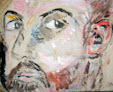
Despite Maxwell Bodenheim's sometimes flamboyant prose, this novel about a worldly-wise adventurer and his young female apprentice hits the mark in unpacking the demimonde. This would have been hot stuff on publication, in 1930, the kind of book that gets dogeared at all the "dirty parts." It can still shock, but more than that offers a believable and thoughtful survey of "the way we live now."
Monday, February 29, 2016

Saturday, February 27, 2016
Oblomov
In Oblomov, Ivan Goncharov created a character of unsurpassable dignity, purity, and decency. The fact that he is, on the surface, lazy and indecisive makes this literary achievement all the more unusual. In a lesson that should not be lost during a filthy political season, Oblomov is able to live an honorable life only by withdrawing from the crooked and low ways of the world around him. He, like a Bartelby, chooses not to get up from the sofa and in so doing becomes a hero.
Sunday, February 21, 2016
The Train Was On Time
Heinrich Boll's first novel, published in 1949, is suffused with the deep concern for humanity and the truthfulness of emotion that would return in books throughout his life. A German soldier, Andreas, is on a train and, he is certain, on his way to death in Poland in 1943. By the time the journey is over, he has explained his life, his regrets, and his fears. A particularly poignant section has him recounting those he has wronged and praying for forgiveness. Boll is never sanctimonious, yet he is always able to find the heart of human tragedy and, even in darkness, find meaning.
Wednesday, February 17, 2016
The Arabs in History
A fair amount of this history by the renowned specialist Bernard Lewis is as dry as the desert from which the Arab people emerged. However, a patient reader who hacks through the thickets of names and dates will be rewarded with a fundamental understanding of the Arab economy, social organization, religion, and downfall.
Saturday, February 13, 2016
Aurora 7
Thomas Mallon's novel covers the day, May 24, 1962, when the Aurora 7 space capsule carrying Scott Carpenter orbited the Earth three times. The book's structure has echoes of Manhattan Transfer, with lives big and small intersecting, but it's primarily about an awkward 11-year-old boy from the New York City suburbs trying to fit into the world. Mallon's prose in this early novel is elegant and smooth without calling attention to itself.
Saturday, February 6, 2016
Pygmy
Chuck Palahniuk's decision to write this novel about a foreign agent's mission to destroy America as a pidgin English diary may be the most interesting thing about it. The mannered prose never really clicks, so it is always calling attention to itself, but it works to strip the subjects down to their essentials: American power, tyranny, religion, love. Palahniuk's callbacks, repetition, and humor are effective, too.
Sunday, January 31, 2016
The Killing of the Unicorn
As a tribute to the murdered Playboy playmate and actress Dorothy Stratten, this account by film director Peter Bogdanovich is loving and seemingly sincere. As a takedown of the Hugh Hefner lifestyle and an argument for his partial culpability in Stratten's death, it is less convincing.
The Genius
Theodore Dreiser's enormous novel (736 pages of small print) boils down to an examination of the artistic temperament and the sex drive. The hero, Eugene Witla, has a weakness for women aged 18 that causes him no end of trouble. He leaves behind a career as a successful painter for supposedly bigger and better things, only to be brought low by another in a series of these women, despite having a decent and loving wife. This 1915 novel scandalized some elements of polite society, and the New York Times review said it left little to the imagination. A modern reader will find that, instead, it leaves almost everything to the imagination. There is nary a bare ankle in sight. Dreiser's style has never been considered his strong point, and his prose is hardly euphonious here, but he manages to sustain interest in a character who is in many respects a silly cad, and that's no small feat.
Thursday, January 28, 2016
A Hero of Our Time
The Russian poet Lermontov's only novel, published in 1840, is a character study of a cynical, cruel and yet heroic military officer, Pechorin by name, who is a reflection of the author. It is startlingly modern in its treatment of human motivations and desires, making American novels of eight decades hence that tackle the same themes seem childlike in comparison.
Thursday, January 21, 2016
A Clue to the Exit
A cold, posturing and largely tedious novel by Edward St. Aubyn about consciousness and death.
Subscribe to:
Posts (Atom)