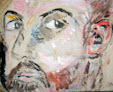
It's hard to imagine a film like Straight Time being made today. For one thing, the narrative is allowed to develop and breathe. In a backyard scene, for example, with Dustin Hoffman, Harry Dean Stanton and Rita Taggart, the camera is still and quiet as the actors do their naturalistic best in a long unbroken take. Hoffman has rarely been better, to my mind, than here playing a career criminal with a mean streak. It is a controlled, modulated and utterly convincing performance. There isn't a clunker in the cast, from Stanton and Taggart to a sinister M. Emmet Walsh, Gary Busey, and then-newcomer Theresa Russell. What also makes the film work is the lack of exposition and motivation: two elements that are among the most tiresome aspects of much current cinema.
Wednesday, March 17, 2021

Death in Venice (1971)
I watched Luchino Visconti's Death in Venice again recently, maybe for the fourth or fifth time, and was amazed anew at the visual language. When Aschenbach (Dirk Bogarde) enters the hotel's lounge on his first night in Venice, the camera picks him up almost accidentally, then follows him through the press of people until he finds a seat. The camera roams slowly, languidly, one might say luxuriantly, over the scene, until the boy Tadzio is revealed like a thunderbolt. This wandering eye is used throughout the film, making the viewer a kind of voyeur. It is also worth noting Visconti's effective use of a slow zoom, common in the 1970s but unaccountably gone today. The story itself, based on the Thomas Mann novella, seems to take a higher road than the source material, which I've read twice and in which I can find little more than an old man's lust for a young boy. Here, Tadzio resembles the photo of Aschenbach's young daughter that the composer kisses at the beginning of the film. We later learn she has died. The scenes with Alfred (an overheated Mark Burns) and Aschenbach are perhaps the film's weakest points, although they add some intellectual gloss. The music of Mahler and the photography make this a stunning film.
Saturday, March 13, 2021
Eyes Wide Open
Screenwriter and novelist Frederic Raphael's book, subtitled "A Memoir of Stanley Kubrick," is a useful portrait of the collaborative process that led to Eyes Wide Shut. It is respectful to the director without being worshipful and seasoned with some fun stories from old Hollywood.
Wednesday, March 10, 2021
One or Another
I was lured to this novel after seeing the painter, playwright and novelist Rosalyn Drexler on a 1970 episode of The Dick Cavett Show. One or Another is stylistically engaging, written in bursts of vignettes that more often than not go off on flights of fancy. The story is simple enough, about a 39-year-old New York woman married to a gym teacher who has an affair with one of his students. But this is a high-concept effort, much more than a simple plot summary would suggest. It is also appealingly frank. The imaginative mind here is impressive, but this novel is more self-expression than communication: a true painter's book.
Sunday, March 7, 2021
The Shadow Over Innsmouth
Perhaps strange to be approaching 60 without ever having read any H.P. Lovecraft, but at least I can thank Michel Houellebecq's interest in the writer for directing me to this volume of short stories. There is a stylistic uniqueness to Lovecraft that is appealing: His sentences are chunky and sometimes clunky, but they match his subject matter to a tee in their weirdness. His only pure science fiction story, The Walls of Eryx, is effective in conveying a creeping sense of doom, and the title story concludes with a truly horrifying twist. All in all, this is a collection that will likely prod a new reader to seek out more from this strange writer.
Wednesday, February 24, 2021
What Unites Us
Dan Rather's optimistic account, subtitled "Reflections on Patriotism," is at its best when he draws on the experiences of his youth in Texas or his long career at CBS News. His interview with Medgar Evers and the tales of how neighbors pulled together during the Depression are highlights. At other times, however, he descends into platitudes.
Monday, February 22, 2021
Spring Snow
Yukio Mishima's Spring Snow, the first installment in a tetralogy called The Sea of Fertility, is filled with all the elements that make a novel both worthwhile and challenging. The writing is simply gorgeous, full of rich metaphors and descriptions of nature; the side trips into history and ideas such as Buddhism are fruitful; and the narrative itself is a classic form rendered with powerful effect. Every page has its moment of beauty, a staggering achievement. Here is just one, about the main character, Kiyoaki Matsugae: "He had never looked forward to the wisdom and other vaunted benefits of old age. Would he be able to die young – and if possible free of all pain? A graceful death – as a richly patterned kimono, thrown carelessly across a polished table, slides unobtrusively down into the darkness of the floor beneath. A death marked by elegance."
Monday, February 15, 2021
The Book of Daniel
E.L. Doctorow found his voice in this, his third novel, published in 1971. The Book of Daniel places a family's destruction on a giant canvas – postwar Left politics – and achieves its ambitions with kaleidoscopic effects. The shifting narrative styles and digressions into subjects like Disneyland and the origins of the Cold War remind me of John Dos Passos's techniques in U.S.A., but they are done here not in imitation but in service of delineating the narrator's character. The novel casts a spell that is not easily resisted.
Tuesday, February 9, 2021
To Live and Die in L.A.
Tuesday, February 2, 2021
How to Write a Sentence
Stanley Fish provides some helpful insights into sentence-writing by focusing on form and exercises: Once you master a form with repeated exercises, you can make your own sentences with whatever content you wish. This is the nuts and bolts of good writing, and Fish's emphasis provides a useful antidote to more artsy-fartsy approaches.