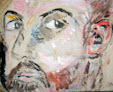
A conflict of power, privilege, and pride, Coriolanus resonates more readily today, perhaps, than others of the tragedies. At first glance a scathing indictment of mobocracy, it is that, but it becomes an examination of family dynamics and the costs of arrogance. In the end, Coriolanus is too extraordinary, in ways good and bad, to be allowed to exist in the world.
Sunday, October 2, 2016

Tuesday, September 27, 2016
The Millstone
The pleasures of this Margaret Drabble novel are manifold. It has wit, depth, humor, and a poignancy that is never forced or facile. It can be summarized in a very few words: A woman has a baby. But where Drabble goes with that basic fact reveals her to be a sensitive and thoughtful interpreter of human experience.
Saturday, September 24, 2016
Nutshell
The plot of Ian McEwan's new novel isn't much: It is essentially a mash-up of Hamlet and a Dateline episode. But the beautiful sentences follow one after another for 200 pages, and the digressions on the state of the world are always on point, and that's enough. The novelty of a fetus as narrator mostly works, although there are some noticeable contortions.
Sunday, September 11, 2016
The Quiet American
No one can remain aloof; everyone eventually becomes engaged. The cynical nonbeliever, Fowler, and the true believer, Pyle, provide the two poles of behavior around which the world revolves. Graham Greene presents the conflict with the lightest finger on the scale, throwing suspense and even humor into the mix. Easily Greene's finest novel in my experience.
Monday, September 5, 2016
Really the Blues
The autobiography of Milton "Mezz" Mezzrow, co-authored by Bernard Wolfe, is a valuable historical document in the history of jazz, but it is also a work that touches on sociology, race relations, language, drug abuse — a partial but detailed portrait of America between the wars. Mezzrow's jazz snobbishness is not appealing, but a reader can surely recognize today that the further jazz moved away from Louis Armstrong, the more of a niche form it became. Mezzrow's ideal was music as a statement of defiance and vitality by black Americans. Would he have thought that rap was the natural descendant of the New Orleans music he so loved?
Sunday, September 4, 2016
Criminal Conversation
Nicolas Freeling gets points for original structure by making this Van der Valk novel a two-parter: Part One being a detective's investigation, if somewhat atypical; and Part Two being a memoir of sorts addressed to the detective. As with others in the series, it is the exploration of human nature, rather than "clues" as such, that recommends Criminal Conversation.
Tuesday, August 30, 2016
Valparaiso
The first half of this novel by Nicolas Freeling, author of the Van der Valk detective series, is a study of character and place (a sailor and the Porquerolles). The second half is a caper that unravels a la Kubrik's The Killing. Together, lubricated with Freeling's world-weary style, they fit nicely.
Friday, August 26, 2016
Eisenhower 1956
This account by David Nichols of Eisenhower's handling of the Suez crisis in 1956 too often reads like a timeline on steroids, with lists of attendees at innumerable meetings. But the effort to get through that underbrush is worth it for Nichols's detailed telling of how the president handled health crises (heart attack, abdominal surgery), a re-election campaign, the British-French-Israeli attack on Egypt, and the Soviet invasion of Hungary. Eisenhower emerges as a principled but pragmatic leader. The least interventionist president of modern times, he went to the United Nations to try to secure a cease-fire in the Suez war, and when that effort was thwarted in the Security Council by a veto of the aggressor nations (and World War II allies), Ike went to the General Assembly instead. It is almost quaint to read about a president who puts peace above all, but as Nichols points out there was a nuclear anvil hanging over the nation's head, and Ike thought the only way to win World War III was to avoid it. It is saddening to read an account of such an admirable leader in the midst of such a disheartening presidential campaign 60 years later.
Sunday, August 21, 2016
The Flemish House
This Maigret story lacks the kind of revelatory excavation of human nature that others in the series provide. The detective is out of his element, among foreigners, which makes him, and eventually the reader, irritable.
Friday, August 19, 2016
Dispatches
Michael Herr's Vietnam book is best when the writer isn't infatuated with his own writing style, particularly the gripping section on Khe Sanh and in his accounts of other correspondents like Sean Flynn, son of the film actor.
Subscribe to:
Posts (Atom)